collectionHQ User Cycle
I built the feedback system every department now uses, in six weeks
Four teams heard from customers every week, and all four lost it. There had to be a better way, so I built one.
- Role
- Senior UX Designer
- Timeline
- May 2026 to now
- What I owned
- Process design, Product design, Build, Rollout
- Status
- Shipped internally
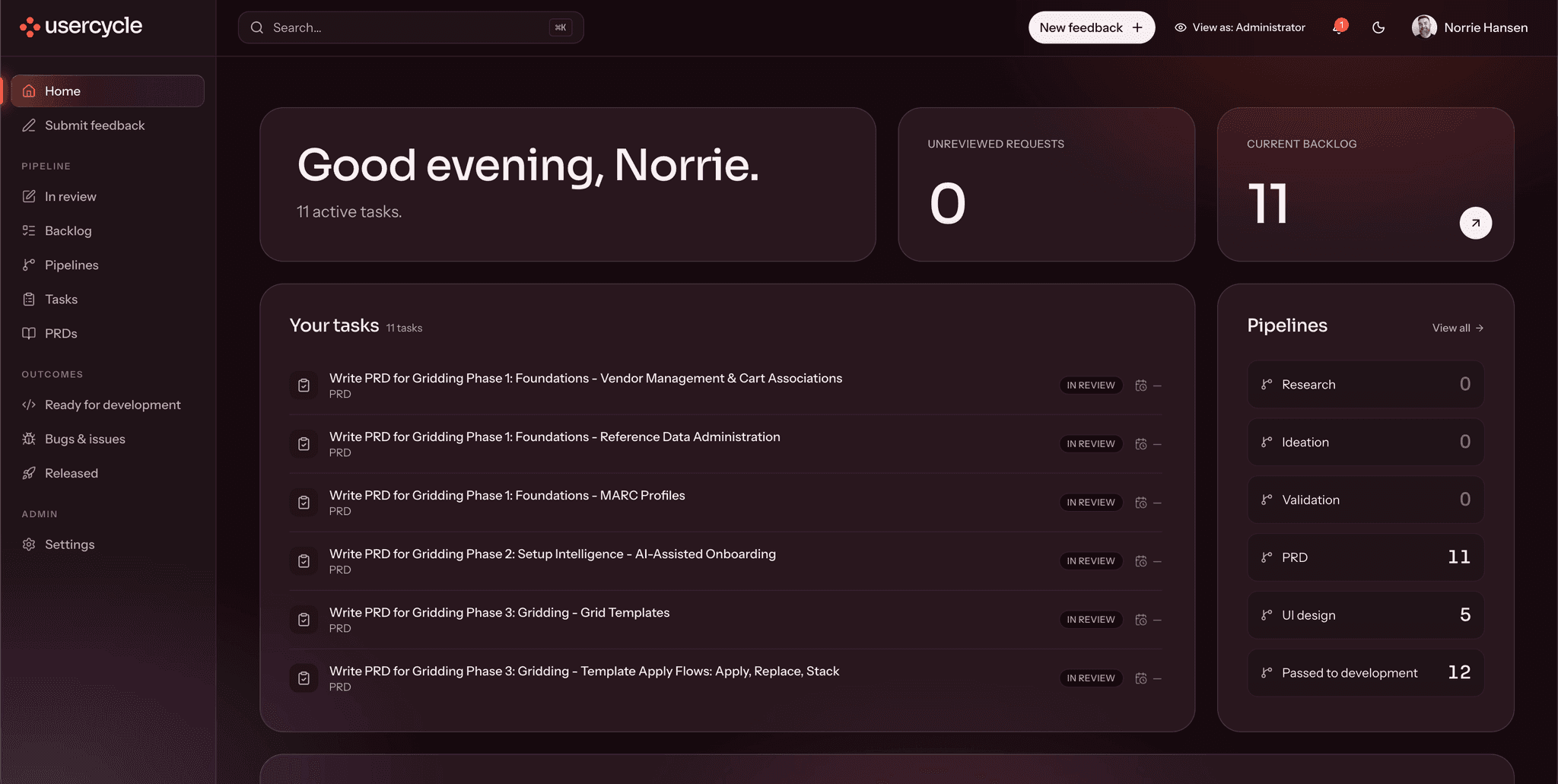 1One box, and no form to learn2The weekly queue, cleared3Our own stages are the board
- 1One box, and no form to learn
- 2The weekly queue, cleared
- 3Our own stages are the board
The problem
Four parts of the business were talking to customers every week, and every one of them had its own way of losing what it heard. Nothing ever got back to the person who'd reported it.
- My role
- The old process wasn't mine, but I could see it wasn't working. I designed and built the replacement in my own time, got the directors' buy-in and rolled it out. I own the process now.
- The team
- The product owner and I go through the backlog together every week. The technical director moved it over to the company's accounts.
The result
How this was measured
That's the count in the system itself since launch, and it covers the whole product range.
The system's own record
How this was measured
This is my own before and after, writing specs to our house structure.
I measured this one myself
How this was measured
That's every department at collectionHQ, not just the product team.
Accounts in the system
Context
Four ways to hear from a customer, four ways to lose it
Our product owner looks after the strategy, so what we're going to work on next and why. The process for handling customer feedback sat there too, and I helped run it. It wasn't my process, but I was the one doing most of the double handling, so I could see exactly where it was falling down. I kept thinking there has to be a better way to do this.
The reason it was broken is that four parts of the business were talking to customers every week, and each of them had come up with its own way of handling what it heard.
Where the feedback went
- Sales would hear what was blocking a deal and write it in their own notepads. Sometimes it got to us on a group call, sometimes in an email, and sometimes it never got to us at all.
- Support and implementation logged ideas in Salesforce, and those went into a spreadsheet that somebody had to pull by hand once a month. Because it was manual, it got skipped whenever we were busy putting out fires, and we usually were.
- Customer success managers would hear things through the grapevine and pass them on, sometimes on Slack and sometimes by email. There was no real process for it across the portfolio.
- My own team ran webinars, research calls, testing and focus groups, and wrote it all up in the research repository. We acted on some of it, but as often as not it just stayed there.
Decision 01 of 04
The fix that became the problem
The bind
Going into the cHQselect beta, we were about to rely on customer feedback more heavily than ever. The product owner came up with a process for it, and I helped run it as it grew. It started as a Slack channel for anyone who was hearing from beta customers. That got messy pretty quickly, so a submission form got attached to the channel, and it fed a spreadsheet that the two of us reviewed.
What I chose
It worked for a while, and then it didn't. We were getting duplicates from different teams and there was nothing to link them up. The form also wrote one row per submission, so anyone who'd had a good customer call, the kind that gives you five separate pieces of feedback, had to file them one at a time. Predictably, they filed the first one. Then the spreadsheet fed a set of pipelines in Miro. I'd move each feature in by hand, prioritise it there, and then create it all over again as a ticket in Jira.
What it cost
It was a complete mess. The same information was going in three times, mostly by me, and we were double, sometimes triple working. It wasn't my process, but most of the work in it was landing on me, and it had turned into a second job.
One place
One place, and a loop that closes
User Cycle brings all of that into one space, where everyone can see the work and track it.
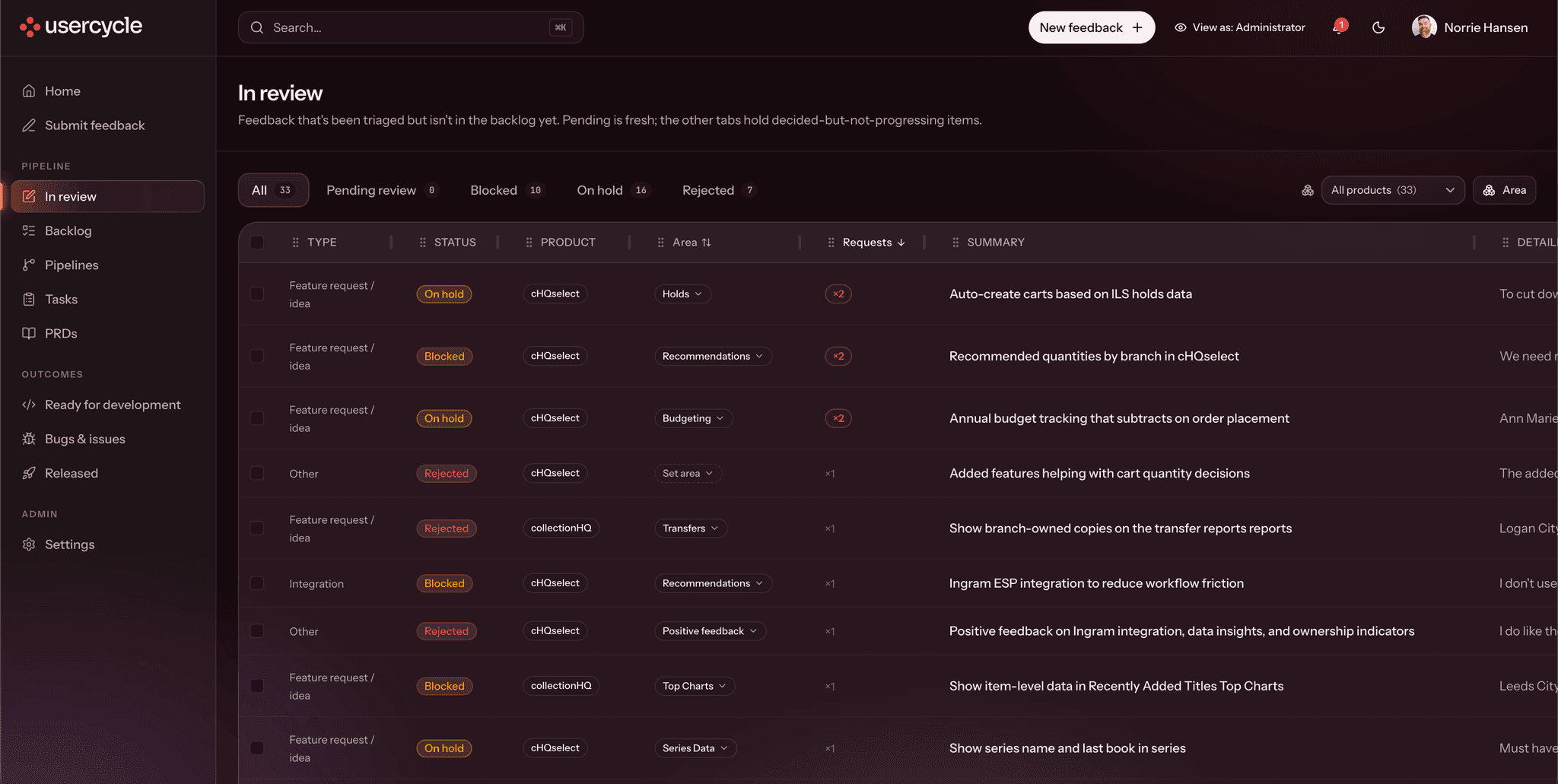
Whenever someone submits feedback, it lands in review, and the product owner and I go through that backlog together every week. We merge anything that's a duplicate, and then we decide what happens to each request. It can go into the backlog, get dealt with straight away, go on hold, get rejected, or get blocked because something's missing. From there it moves through the six stages we actually use, which are research, ideation, validation, the product spec, design and build.
Crucially, whoever submitted the feedback can log in and see exactly where their request has got to. The spreadsheet could never do that, and it's a fair part of why people had stopped bothering to report anything.
It's amazing, and for CSMs in particular, it's really helping us support our customers and make them feel heard, especially when closing the loop on their ideas we've released.
Meryl Emslie, Vice President of Customer Experience, collectionHQ
What the AI does
What the AI actually does
It does five jobs, and they're all boring
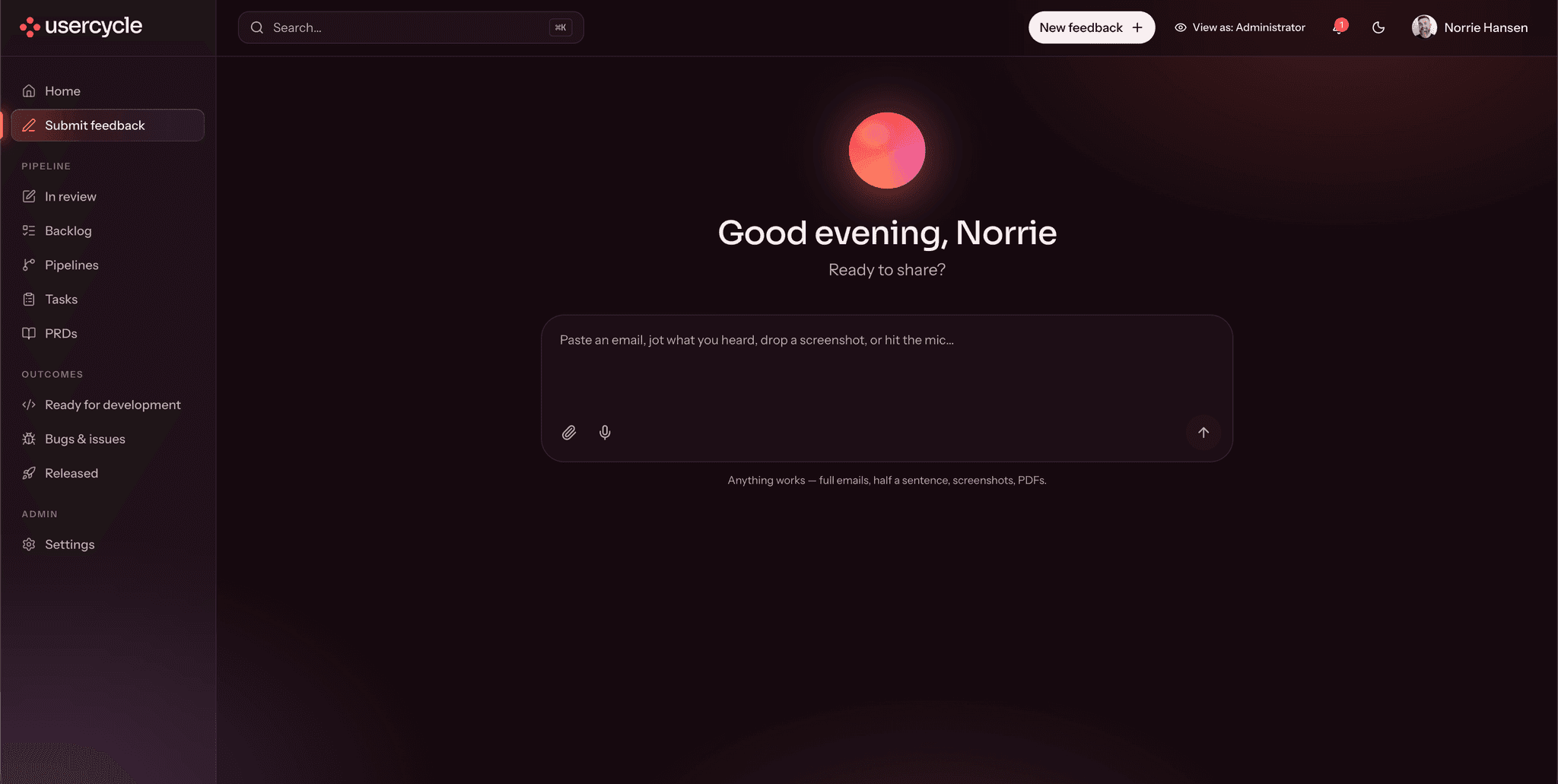
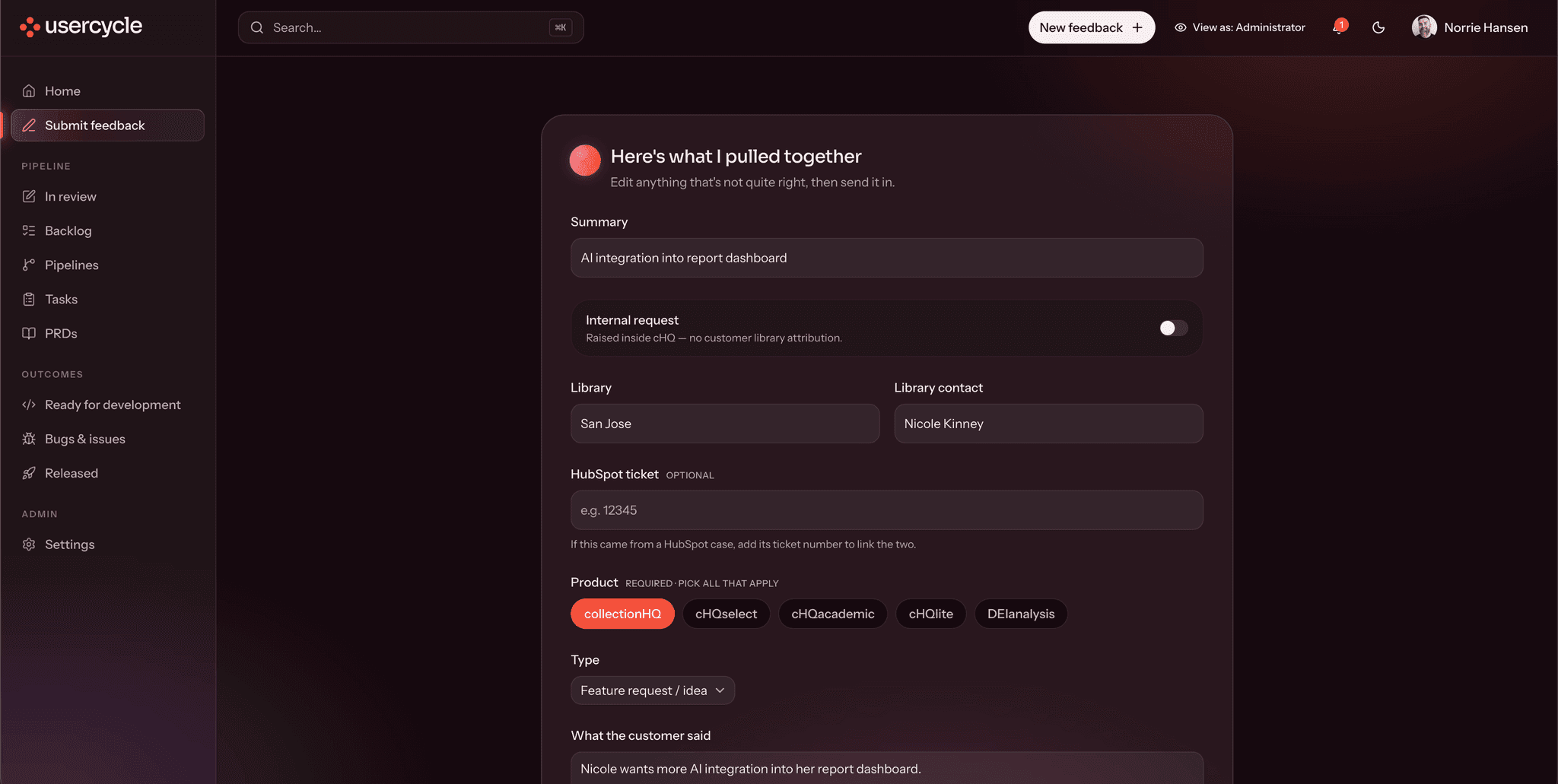
- It reads feedback however it turns up, whether that's typed in, a screenshot of an email or a photograph.
- It asks a follow-up question if you've missed something the design process needs, so we don't take in a request nobody can act on.
- It splits one customer call into separate requests, so you write it up once and get five clean items out of it instead of one.
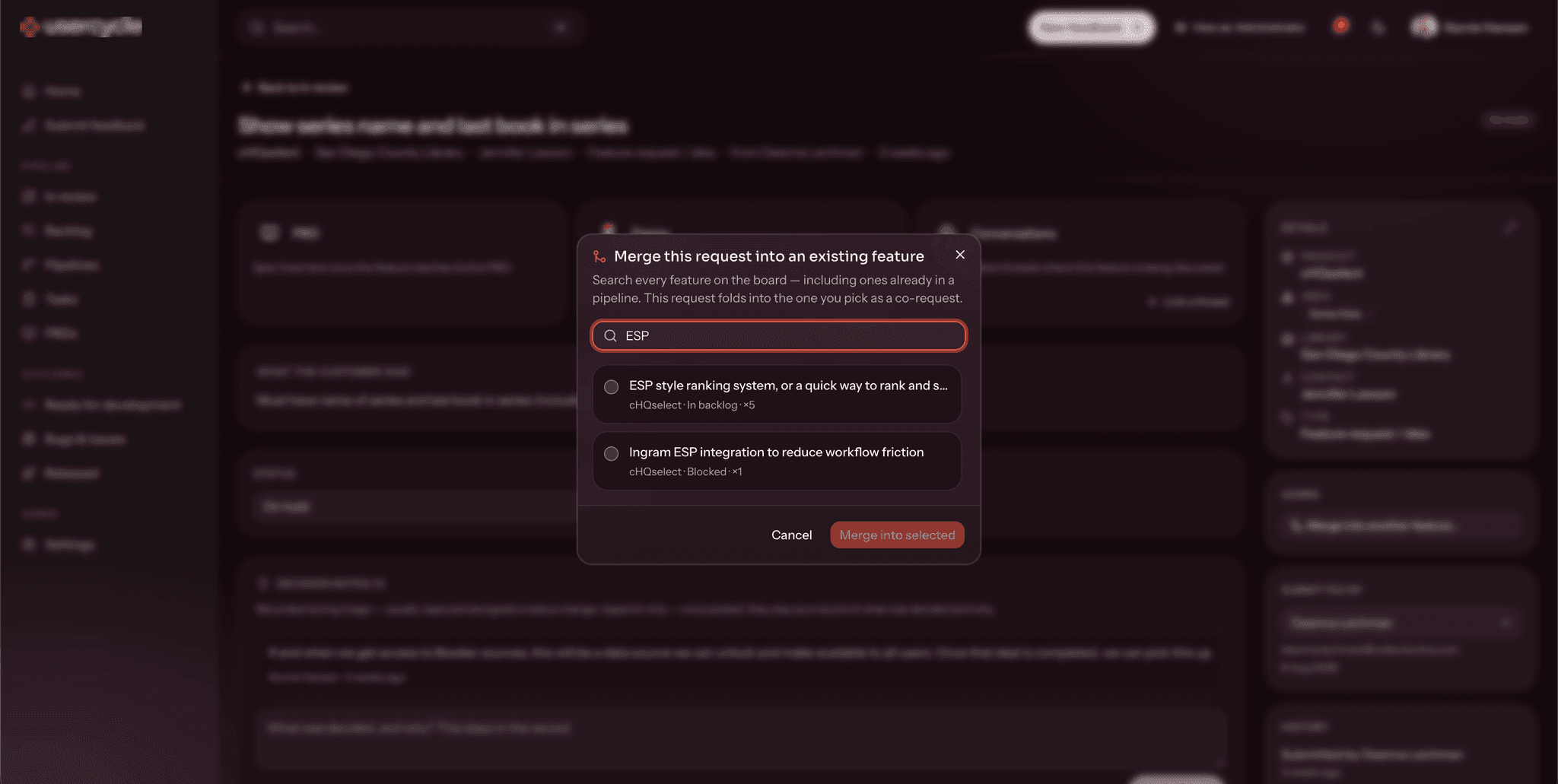
- It checks new feedback against everything that's already in the system, and shows the submitter anything that looks like a duplicate.
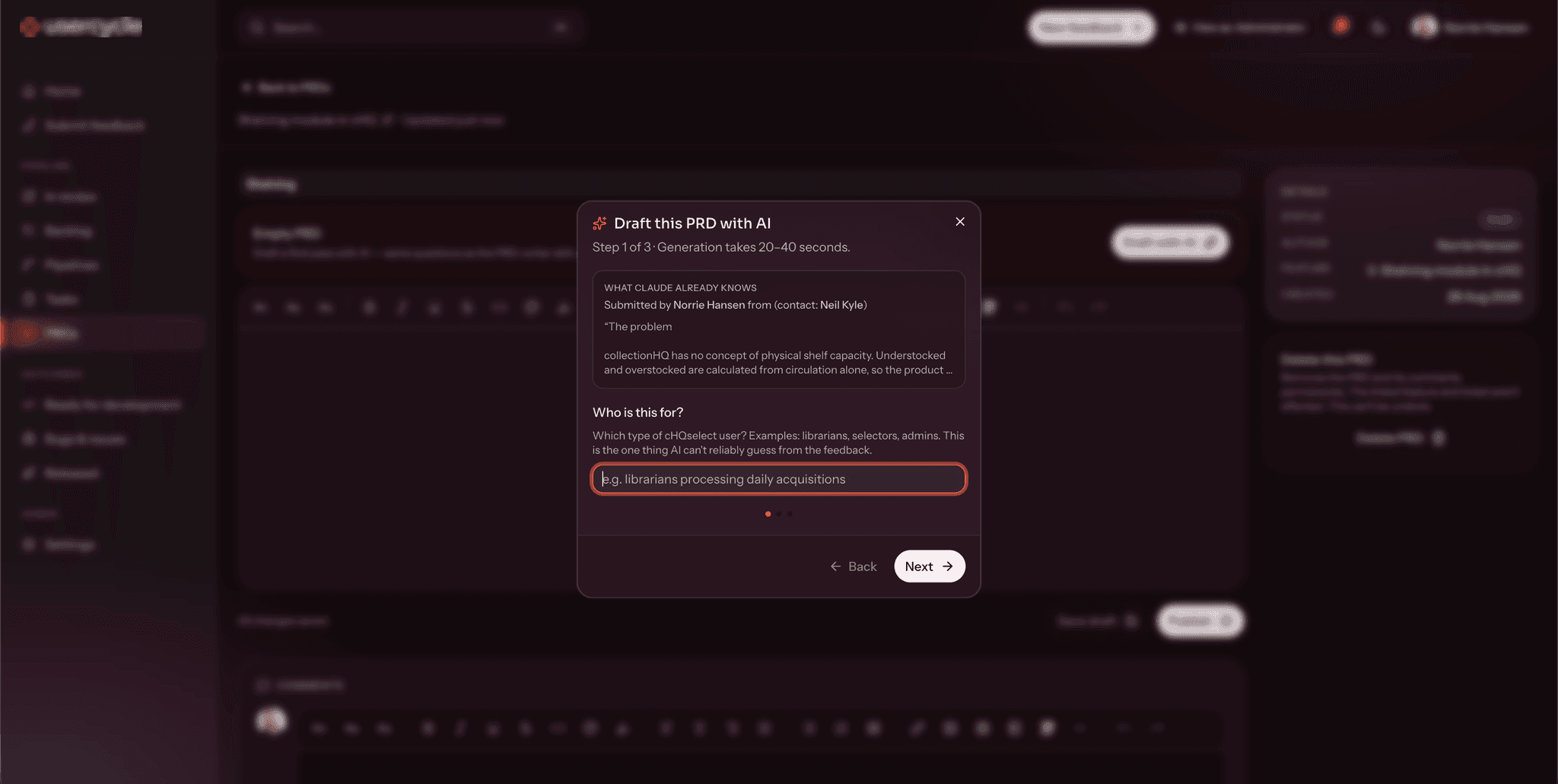
- It drafts the product spec from the context it's already got and our house structure. Writing one by hand used to take half a day, and with a draft to work from it takes thirty minutes.
Decision 02 of 04
The AI doesn't make any of the decisions
The bind
The system has enough context to triage and prioritise on its own. If I'd let it, we'd have saved real time every week.
What I chose
I gave it the boring half and kept the judgement for us. When it flags a duplicate, it's only making an offer. The submitter sees the match and can merge it or leave it, and if they're not sure, they just leave it alone. Merging still gets us something, though. Duplicates end up as a single request, so the system counts how many times people have asked for the same thing. That lets us see what's hot amongst our users, and not just what came in most recently.
What it cost
Triage is still a conversation between two people once a week, and I still fine-tune every spec it drafts. I'd rather be slower and able to answer for every decision than faster and automatic.
Decision 03 of 04
I let the stages write their own tickets
The bind
The thing I'd missed for years was sitting in plain sight, which is that our process doesn't change. Research is the same set of tasks every time, and so is validation, and so is writing a spec, and so is design. And every single time, I'd been typing out that same set of tickets again by hand.
What I chose
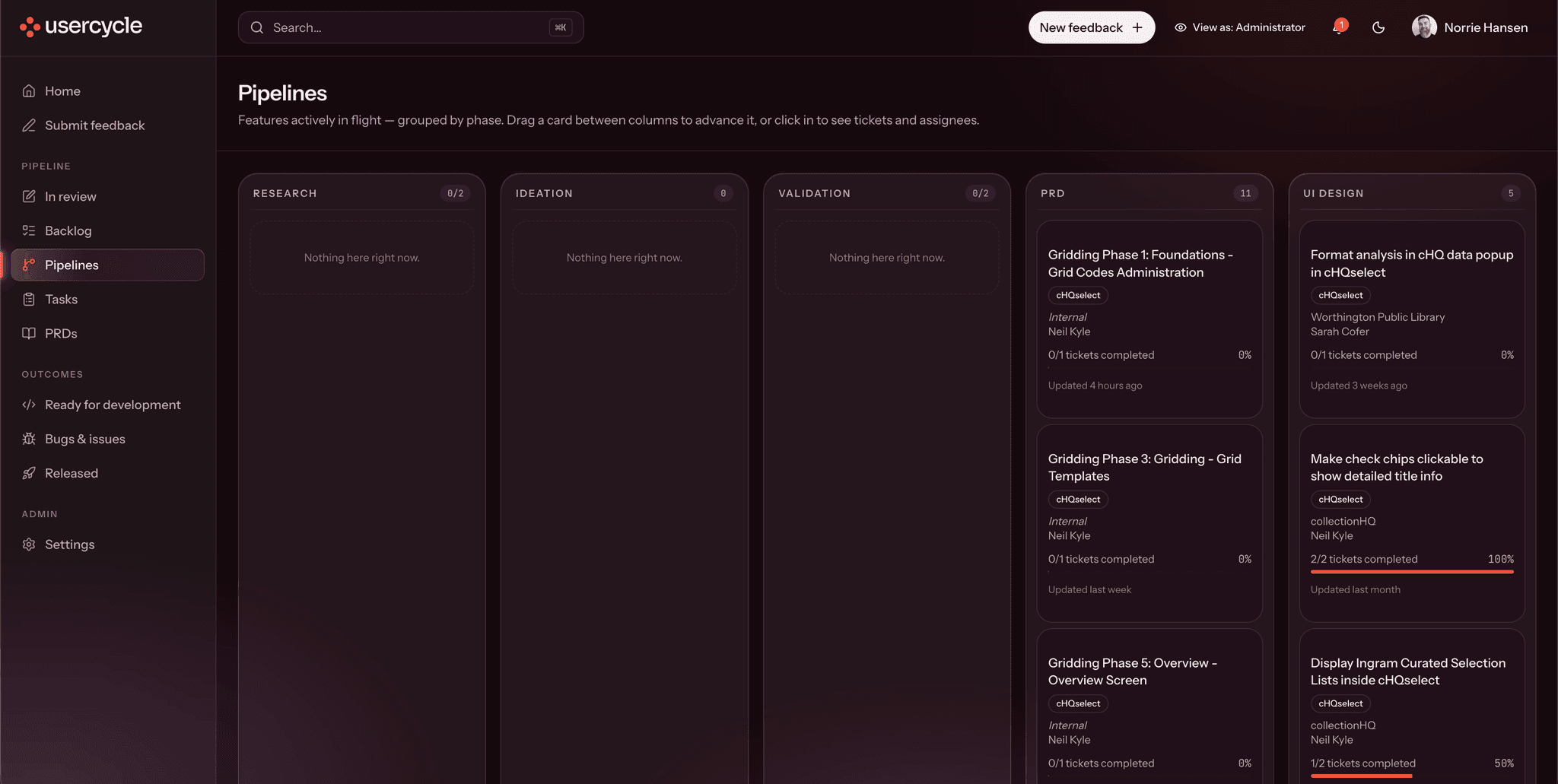
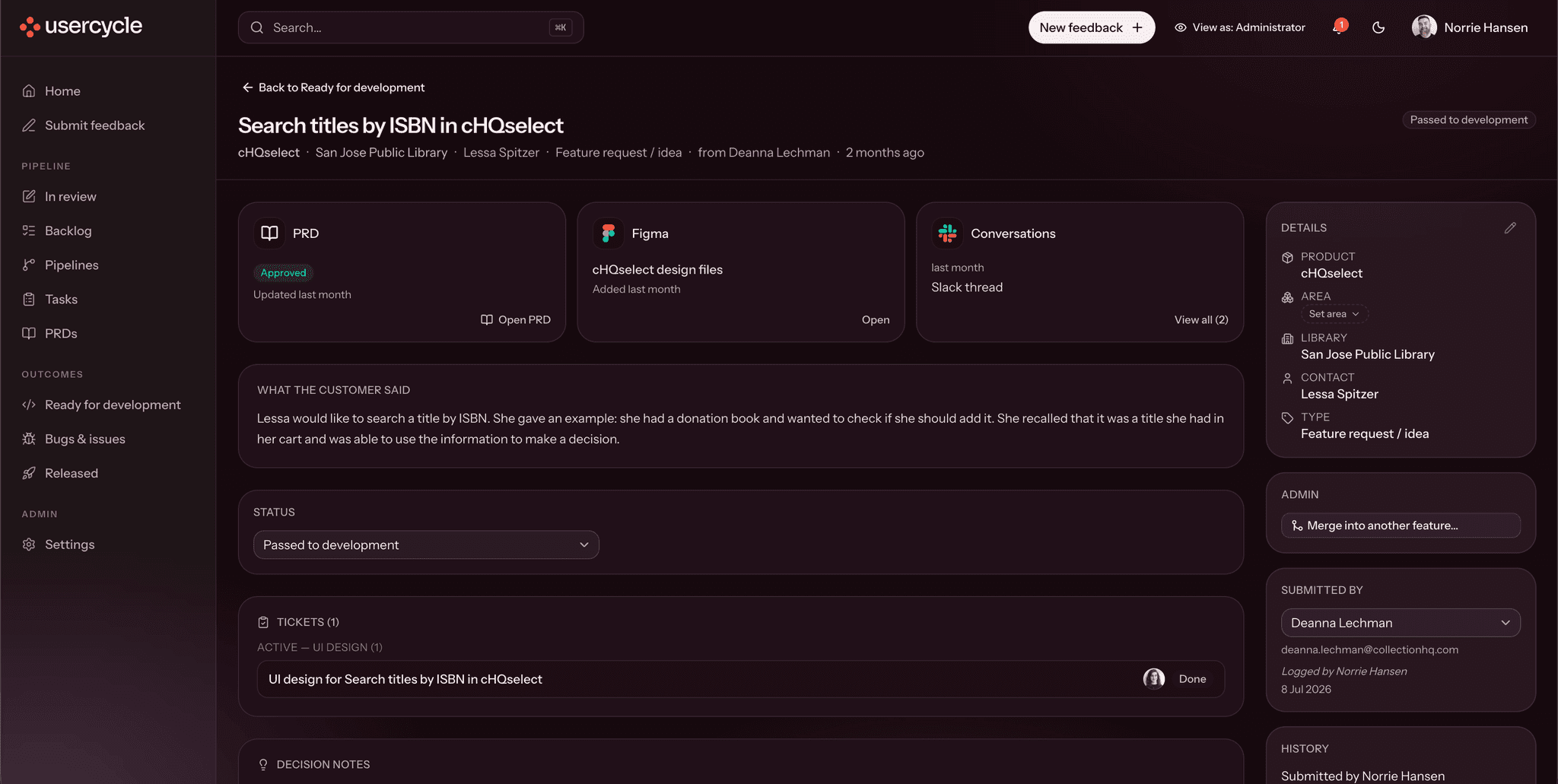
Now the stages create their own. The minute you move a feature into research, its tasks show up on the product team's board, ready to assign. Each feature also carries everything behind it, so that's links to the Slack threads where we argued it out, the Figma files, the spec, and the customer feedback that started it. When a developer picks up a build, they can see who asked for it, what we agreed, where the designs are, and what we settled in a thread they never saw.
What it cost
Our process now lives inside a product, so if we want to change how we work, we've got to change the software and not just a habit.
Decision 04 of 04
I built the fix first, and then I got the buy-in
The bind
The process wasn't mine to change, and it kept getting worse. I could've written up a proposal, but it's a lot easier to say yes to something you can click through. There wasn any room on the roadmap for internal tooling, so waiting for some wasn't a plan.
What I chose
So I took the bull by the horns and built the first version in my own time, so I could put it in front of people and say, this is how we should do this. I used Figma and Claude Code to design and build it, it runs on React, Supabase and Vercel, and login is gated to our Microsoft single sign-on. I got the product owner on board, and then I put a presentation together for the managing director and the portfolio manager. My proposal was that I'd like to use it internally, and that there might be scope for it more widely across the group. The answer on using it internally was yes, and the process has been mine ever since. It took six weeks from idea to release.
What it cost
It ran on my personal accounts until the technical director moved it onto the company's. Nobody's made a decision about the wider group.
It solves a real problem in the customer voice of the pipeline, which will have a big impact on our process.
Steve Legowski, Managing Director, collectionHQ
What it changed
What it didn't fix, and what it changed
It didn't replace everything, and I'm not going to pretend it did. We still use Smartsheet and Miro, just not for anything to do with feedback. What it has done is let us move away from Jira, and it covers the whole product portfolio, not just cHQselect.
The bit I didn't expect was that it would change how I think about designing. I've always designed in Figma and then handed over to the developers, and for plenty of work that's still the right way to do it. But after building something that looks and behaves the way this does, I'm not precious any more about where the design happens.
Validation is the clearest example. If I can get a clickable prototype that people can really use in hours rather than a week, there's not much reason to test an idea any other way. That changes what's worth prototyping, and it means I'm happy to be wrong in front of a customer a lot earlier.
Where AI sat
What I used it for, and what I didn’t trust it with
I designed it in Figma and built it with Claude Code, on React, Supabase and Vercel. But I didn't hand over the judgement. Triage is still a weekly conversation between two people, and I fine-tune every spec the model drafts before it gets to an engineer.